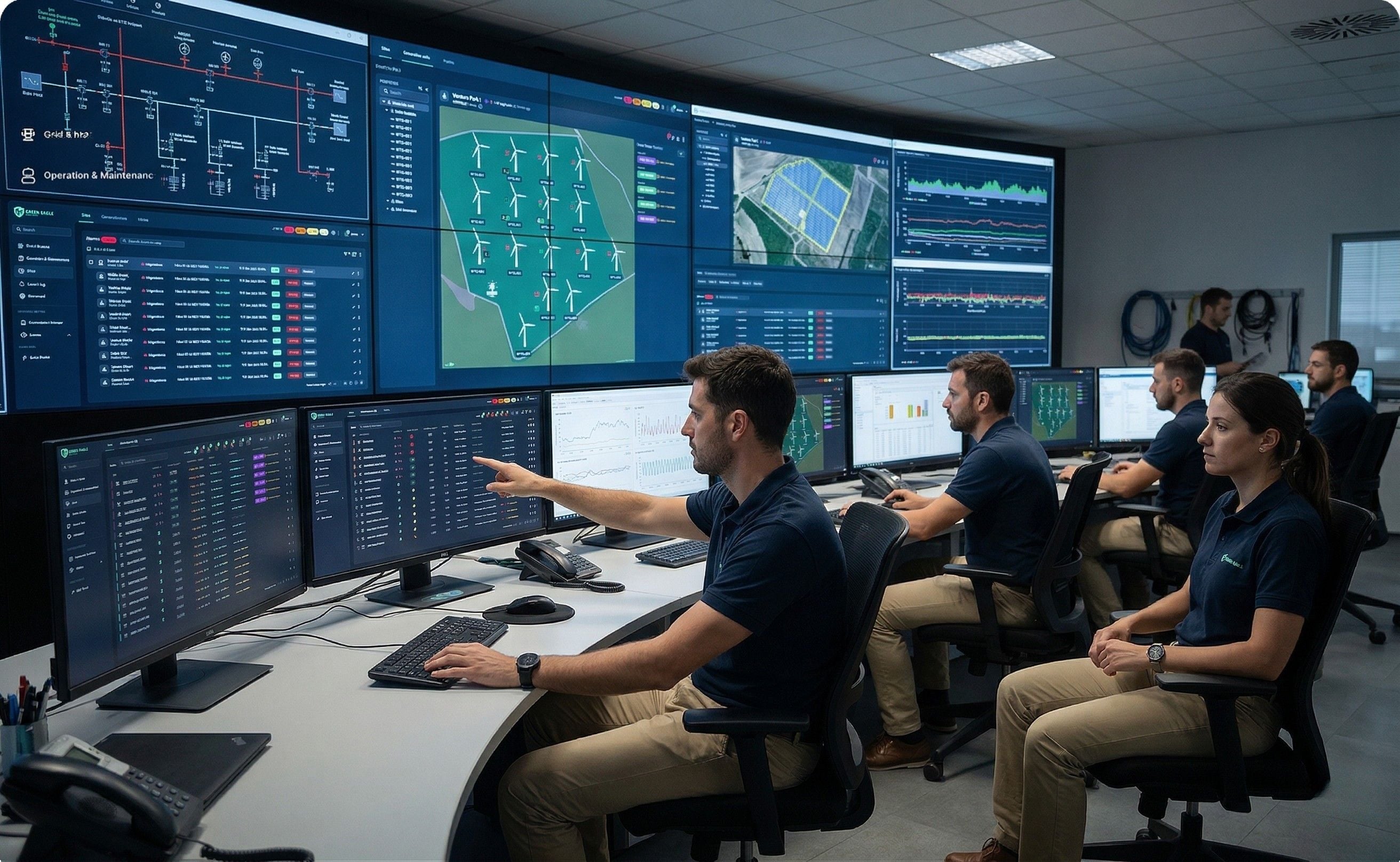
The more renewable energy infrastructure you add, the more operational complexity you inherit. At a certain scale, manual processes don't just struggle — they break. This is why automation has moved from a nice-to-have to a non-negotiable.
The energy transition is accelerating. Wind farms, solar parks, battery storage assets, and substations are being deployed at unprecedented speed across multiple geographies, grid connections, and technology types. For operators and portfolio managers, this growth brings opportunity — and a compounding operational challenge that conventional tools and workflows were simply never designed to handle.
Renewable energy infrastructure is inherently distributed. Unlike a centralised power plant, a renewable portfolio is a constellation of assets — each with its own SCADA system, communication protocol, alarm logic, and OEM-specific behaviour. Managing it well requires not just visibility, but standardisation, speed, and the ability to act autonomously at scale.
The distributed nature of renewable energy infrastructure
A wind portfolio of 50 sites is not simply 50 times the complexity of one site. Each location introduces its own set of variables: different turbine brands and models, different substation configurations, different grid operators, and different local regulatory requirements. Add solar, storage, or hybrid assets to the mix, and the operational matrix grows exponentially.
The core challenge is fragmentation. Without a unified operational layer, teams end up managing:
- Separate SCADA systems per wind farm or solar park, with no shared view
- Different fault-handling protocols for every OEM and turbine model
- Manual alarm triage across dozens of inboxes and dashboards
- Inconsistent reporting formats that make portfolio-level analysis slow and error-prone
- Compliance monitoring done manually, with inherent risk of delay or oversight
This is not a technology problem — it is a structural one. The more renewable energy infrastructure you operate, the more these fragmentation costs compound. Response times slow down. Errors multiply. And the only traditional solution — hiring more operators — does not scale economically.
Why traditional management models fail at scale
Most operational models in the energy sector were designed for a world of fewer, larger, centralised assets. They rely on experienced operators monitoring dashboards, manually triaging alarms, and executing reset procedures step by step. In that world, the model works. In a distributed renewable portfolio, it does not.
Consider what happens when an operator is responsible for monitoring 1,000 turbines across 30 sites. At any given moment, there may be dozens of simultaneous alarms — some critical, some routine — across different technologies, brands, and geographies. The cognitive load alone is unsustainable. And when reaction time is measured in minutes, a 30-minute manual fault resolution cycle represents real, quantifiable energy loss.
The scalability ceiling
Without automation, an operator can effectively manage approximately 1,000 turbines. With automated fault detection, reset execution, and escalation workflows, that same operator can oversee 3,000 turbines — a 3x increase in capacity without adding headcount.
The problem is not the people — it is the model. Manual workflows create three structural bottlenecks that automation directly addresses: reaction speed, protocol consistency, and scalability.
This is not a hypothetical challenge. Independent service providers managing multi-brand renewable fleets at global scale face exactly these conditions today — hundreds of alarms per day, dozens of OEM-specific protocols, and a control room workforce that cannot grow in proportion to the portfolio. The following use case illustrates how one global ISP confronted this problem directly, and what changed when automation replaced manual workflows.
How a global ISP scaled to 3,200 turbines without adding headcount
Our use case demonstrates how an independent service provider operating 3,200 wind turbines across four continents was handling 450 alarms per day with an average 30-minute manual resolution cycle per fault. With each OEM running its own SCADA logic, standardised response was impossible — and growth was outpacing the team's ability to maintain control.
Read the full story: ISP Use Case →
From manual to autonomous: what changes
The shift from manual to automated operations is not simply about technology — it is about redesigning how control rooms work. The following comparison, drawn from real-world operations, illustrates the concrete difference:
| Aspect | Manual operation | With ARSOS |
|---|---|---|
| Protocol execution | Operator dependent, hard to standardise | Automated and standardised |
| Reaction time | Dependent on operator's workload | Immediate |
| Asset protection | Reactive | Preventive |
| Traceability | Partial | Complete |
| Compliance | Monitored manually, risk of delay | Continuously monitored with automatic enforcement |
| Human error | High in complex, high-pressure scenarios | Reduced through rule-based automation |
| Portfolio scalability | Requires proportional increase in staff | Scales without linear headcount growth |
These are not incremental improvements. Each row represents a structural change in how renewable energy infrastructure is managed — moving from human-dependent, reactive processes to rule-based, preventive, and fully traceable operations.
Operational complexity requires data, standardisation, and automation
Three capabilities underpin any serious response to the complexity challenge of distributed renewable energy infrastructure:
1. Centralised data — A unified operational data layer that connects every asset, regardless of technology or brand, into a single monitoring environment. Without this, operators are perpetually fighting information silos. With it, they gain immediate, portfolio-wide visibility into what is happening, where, and why.
2. Standardisation — Consistent operational protocols that execute identically across every OEM, turbine model, and asset type. This eliminates the variation that creeps in when individual operators handle each situation differently, and it ensures that every action is traceable and auditable.
3. Automation — The execution layer that acts on data and protocols without waiting for human instruction. Automated fault detection triggers resets within seconds. Curtailment requests from the TSO are applied in real time. Unresolved issues are escalated automatically to CMMS as work orders. The control room shifts from reactive firefighting to exception management.
Why automation is not optional
With distributed assets and critical grid operations, the combination of reaction speed requirements and portfolio scale makes manual-only workflows structurally incompatible with sustainable growth. Automation is not a cost-cutting measure — it is the operational foundation that makes scaling renewable portfolios viable.
The measurable impact: operational performance in numbers
The business case for automation in renewable energy infrastructure management is not theoretical. The following performance data reflects the real-world impact of moving from manual to automated operations:
| Metric | Without ARSOS | With ARSOS |
|---|---|---|
| Average escalation time | 5 min | < 1 min |
| Average fault resolution | 30 min | 5 min |
| Annual O&M savings | 0 | 200–600 €/MW/year |
| Operator capacity | 1,000 turbines | 3,000 turbines |
These figures translate directly to energy yield, O&M cost reduction, and the ability to grow a portfolio without a proportional increase in operational headcount. At portfolio scale, the difference between a 5-minute and 30-minute fault resolution time can represent tens of thousands of euros in recovered production annually.
What this means for software selection
When evaluating software for managing renewable energy infrastructure at scale, the complexity challenge described here should be a primary lens. The right platform must be able to:
- Connect to heterogeneous assets across multiple technologies, brands, and communication protocols (OPC-UA, Modbus, IEC 104)
- Provide a unified operational view from portfolio level down to individual device diagnostics
- Execute standardised protocols autonomously, without requiring manual intervention for routine events
- Escalate intelligently to CMMS or operations teams when automation cannot resolve an issue
- Scale without requiring proportional increases in control room staffing
- Meet the highest cybersecurity standards, given the critical infrastructure nature of grid-connected assets
A platform that only provides visibility — without an execution layer — solves part of the problem. Centralised monitoring reduces the cognitive load on operators, but it does not eliminate the bottleneck of manual response. The next step, and the one that fundamentally changes the economics of operating distributed renewable energy infrastructure, is automation that executes on your behalf.
Ready to move beyond manual operations?
ARSOS Automation Suite is an automation platform designed to manage the full complexity of distributed renewable energy infrastructure — delivering real-time monitoring, automated curtailment, fault response, and substation automation across +90 GW of connected capacity and +2,000 sites. Learn more at greeneaglesolutions.com.